Museums of Plumas County
Plumas County has a unique and varied history behind it. Experience some of Plumas County’s history as you explore the nine museums, each offering something distinctive to that locale in Northeastern California’s rural area.
Discover how people lived, worked, and played in the small rural communities of what is now Plumas County.
Learn stories of Native American Maidus, gold-seeking miners, Chinese immigrants, timber-falling lumberjacks, pioneer families who settled in the region, cowboys, and railroad Gandy dancers.
Plan Your Day
Plumas County is well known for its outdoor destinations, but there is more to offer. If you are interested in history, the Museums of the County should be included with your visit. The museums have wonderful tales of the area.
Several of the museums have living history days during the year, and the Western Pacific Railroad Museum offers special train rides at different times of the year. You can plan a whole visit around just visiting the county’s museums or add one or two to your visit if the weather gets bad or you need a rest.
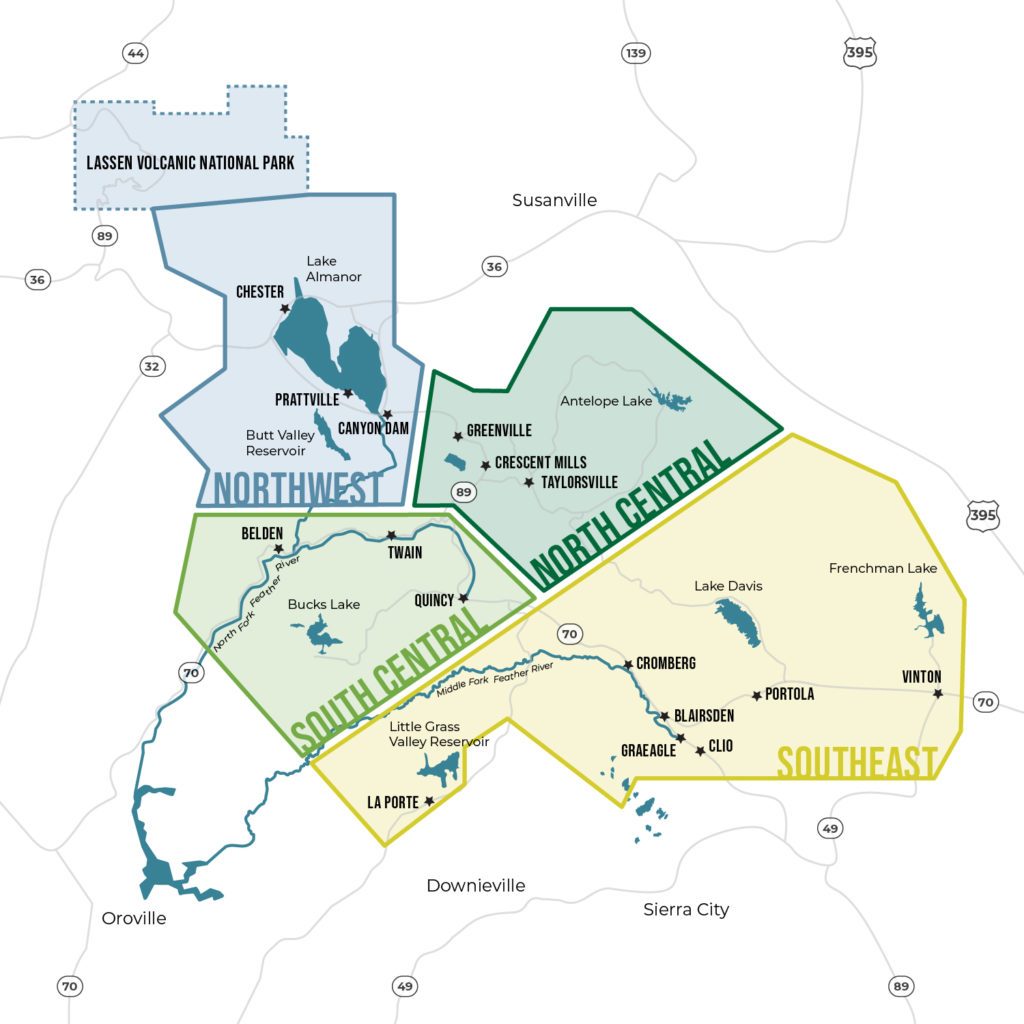
Below are highlights of our many museums. For more detailed information, please call the museums directly. By clicking any of the images below, you can go to a specific county region.


Museums of Northwest Plumas County
Chester
Chester is home to both the Chester Museum and Collins Pine Museum


Chester-Lake Almanor Museum
Chester Museum was created to preserve and present the history of the inhabitants of the Almanor Basin, the native peoples, the Maidu tribe, and the cultural changes that the white man brought from the 49’er days through the mid-20th century. The museum possesses an outstanding collection of finely made native Maidu baskets and Stone Age artifacts.
The 1914 flooding of one of the largest alpine meadow systems in California by Great Western Power Company, the precursor of Pacific Gas & Electric, wiped out nearly all signs of the mid-19th-century settlement by miners and ranchers, as well as the burgeoning tourism industry exemplified by the town of Prattville and tourist resorts like Bidwell’s Meadow View and the Bunnell House.
The museum photo collection takes one back through the early settlement by dairy and cattle ranching families, the creation of the town of Chester as a replacement for the drowning of earlier settlements and tourist meccas, and the eruptions of Lassen Peak that revitalized the tourism industry, including the creation of mountain resorts like Drakesbad.
The Chester Museum recently added the Bunnell Safe from the Bunnell Hotel to its collections. The safe has a fascinating history and was lost from the area for many years; it has now been returned to the Chester Museum.
For those with more than a passing interest, historian and museum director Marilyn Quadrio’s Big Meadows and Lake Almanor book is for sale in the Museum/Chester Library or B&B Booksellers.
Marilyn Quadrio may be reached at 530-596-3011 or by email: marilynquadrio@gmail.com for additional information on the museum.
A compact, century-old steam locomotive known as the “Dinky” is on display on the Collins Pine Co. lawn along Main Street.
The “Dinky” was recently discovered at the bottom of the nearby Butt Valley Reservoir during repairs to the dam. It is believed to have been used to help build the dam around 1913.
Collins Pine Museum


Collins Pine Museum
- 500 Main Street, Chester
- Hours of operation are 9:00-5:00, Wednesday through Saturday, mid-May to mid-October.
The museum building is shaped like the original sawmill, which operated from 1943 to 2001. It is constructed of solid wood posts and beams. The museum features information about lumbering, forestry, sustainability principles, exhibit panels, and a mini theater.
The outdoor exhibit may be seen year-round. It features rolling stock retired from the Collins Pine lumber mill and 15 pieces of equipment dating back to the 1930s, 40s, and 50s.
Museums North Central Plumas County


Indian Valley Museum
- Located at the corner of Main Street and Cemetery Road, Taylorsville, in the Mt. Jura Gem & Museum Society Building.
- Open Saturday and Sunday from 1 to 4 pm May through the last weekend in October.
The Indian Valley Museum features displays and data relating to the rich traditions of mining, ranching, and logging in the Indian Valley. One room, dedicated to the native Maidu Indian culture, features a fine collection of Maidu baskets. Other artifacts represent the early settlers of the Indian and Genesee Valleys from the 1850s to the present. Mining equipment and a blacksmith shop are on display outside the museum. A museum annex features larger exhibits, including a 1932 fire engine and dairy equipment. An 800-square-foot room features a large display of rocks, minerals, and mineral carvings. Rocks and minerals are also available for sale.


Greenville Museum
The Greenville Museum was housed in the 1877 Branston McInty Dry Goods Warehouse. The Greenville Museum was destroyed in the Dixie Fire. As the community of Greenville rebuilds, they will rebuild a local museum. Greenville has a very interesting history and has been an important part of Plumas County.
Museums in South Central Plumas County
 The Variel House at the Plumas County Museum in Quincy
 Mountain Maidu basket collection at the Plumas County Museum
Plumas County Museum
- 500 Jackson Street, Quincy. Behind the Quincy Courthouse
- Hours vary, please call ahead.
Cultural and home art displays are complemented by technological displays featuring agriculture, gold mining, logging, and railroad history. In accordance with the “living museum” philosophy, most exhibits are rotated periodically.
Collections include Maidu Indian basketry, pioneer weaponry, archaeology, and natural history. Outdoors is a blacksmith shop, miner’s cabin, and larger mining and logging equipment and agricultural implements.
A mezzanine gallery features exhibits of local artisans, and an outstanding archival library is utilized under supervision for research projects. Special events at the museum include the Christmas “Wassail Bowl” and a Summertime Open House, which include tours of the 1878 Variel Home adjacent to the museum property. Area literature, histories, artwork, and other items are on sale in the museum bookstore.
Next to the Plumas County Museum is the historic Variel Home. Originally built by Joshua Variel in 1878, this restored three-story Victorian is furnished from the museum collection to represent a middle-class family home in turn-of-the-century Plumas County. Old-fashioned gardens around the home provide a delightful rest stop. The home is open for tours from May through September (call for schedule) and by special appointment.
Museums in Southeast Plumas County
Western Pacific Railroad Museum
- 700 Western Pacific Way, Near Old Town Portola
- Open seasonally, April through October, 10 am – 5 pm daily. Limited winter operations, call for hours.
- Admission is $10 for adults, $5 for kids, and free for kids four and under. A family pass is $25.
This world-renowned museum was established in 1983 by the Feather River Rail Society. It preserves general railroad history, equipment, photos, artifacts, historical information, and data. Housed in a former Western Pacific diesel shop, the museum has approximately 12,000 feet of track and 170 pieces of equipment.
WPRM gained two new unique railroad cars during 2022. The Bragg Crane lifted the car on October 23, 2022, and placed it on its trucks. The museum crew then used Western Pacific SW1500 switcher 1503 to position WP 302 in the yard. Work has already begun to weatherproof the car, and initial restoration is planned for Spring 2023. If you are interested in helping Western Pacific Railroad Museum raise funds to complete the restoration, please visit Fundrazr.
Seneca Hospital in Chester donated the train car below to the WPRM. Visit our blog for more information and plans for this donation.
Visitors can climb aboard an extensive collection of train cars and locomotives and even drive a locomotive themselves (reservations required). Train rides in cabooses and vista flats around an enamel balloon track during summer weekends, Memorial Weekend through Labor Day Weekend.
This museum is a must-see for train buffs of all ages. It is also a great museum for kids because it is hands-on. Feel free to climb up on the walkways of equipment and look in the windows. For your safety, the museum requests that you do not climb under, on top of, or between pieces of equipment.


Plumas Eureka Museum
- The museum is part of Plumas Eureka State Park, five miles west of Graeagle on Johnsville Road. (A-14 west of Highway 89)
- It is open daily from 8 a.m. to 4 p.m. in summer and when staff is available during the rest of the year.
Besides visiting the museum, there is excellent hiking, and the park is known for its fall colors and spring wildflowers.
This indoor-outdoor museum preserves the rich heritage of the Feather River Country’s gold mining legacy. Housed in a restored miners’ boarding house, this museum displays mining tools, photographs, pioneer household items, working models of antique mining machinery and antique skis, and animals native to the park.
The rustic, five-story Mohawk Stamp Mill, which processed raw gold-bearing quartz, is among the nearby buildings, which also include a blacksmith shop, a bunkhouse, and a miner’s home.
During the summer, docents and park staff conduct tours of the buildings and blacksmithing demonstrations. Visitors can also enjoy fishing, nature study, and hiking within the park.
Gold Discovery Days are held in July each year. The free, family-friendly event features many fun, historical activities, including gold panning, wagon rides, pine needle basketry, wool spinning, candle making, and woodworking.
This is another great museum to visit with children. In the summertime, supervised gold panning programs are offered along Jamison Creek. The park also offers a junior ranger program.
Please note that California State Parks now have a special program, The California Adventure Pass, where every 4th grade family can register for a free California Park Pass good for one year.


Williams House Museum

- 424 E. Sierra Ave. (Highway 70), Portola.
- Open Tuesday through Saturday,10 a.m. to 3 p.m., or by appointment. Closed in January.
This 1931 log home, on the California Historic Register, was a former residence and gas station owned and operated by a Portola couple, Sam and Ethel Williams. Exhibits, documents, photographs, and quilts depict local family history and tell the story of the town’s lumber, mining, and railroad industries.
Jim Beckwourth Museum
Jim Beckwourth Museum Rocky Point Road, east of Portola. Open weekends from 1-4 p.m. Memorial Day through Labor Day; other times by appointment.
Plumas County pioneer Jim Beckwourth’s authentic log cabin trading post and “hotel,” featuring V-notch construction. Beckwourth was one of the few pioneer leaders of African-American descent. He discovered the lowest pass over the Sierra.
Beckwourth was the only African American who recorded his life story, and his adventures took him from the everglades of Florida to the Pacific Ocean and from southern Canada to northern Mexico.
Frank C. Reilly Museum
Frank C. Reilly Museum Main Street, La Porte. Open Saturdays, Sundays, and holidays, Memorial Day to Labor Day, 11 a.m. to 4 p.m.
Features displays of La Porte’s gold mining and ski racing history. Named after a longtime La Porte resident, the museum was founded by the Frank C. Reilly chapter of the Clampers, a historical organization of which Reilly was a member. The club’s archives are in the museum, along with local artwork and a “hodgepodge” of other items, including an extensive butter dish collection.